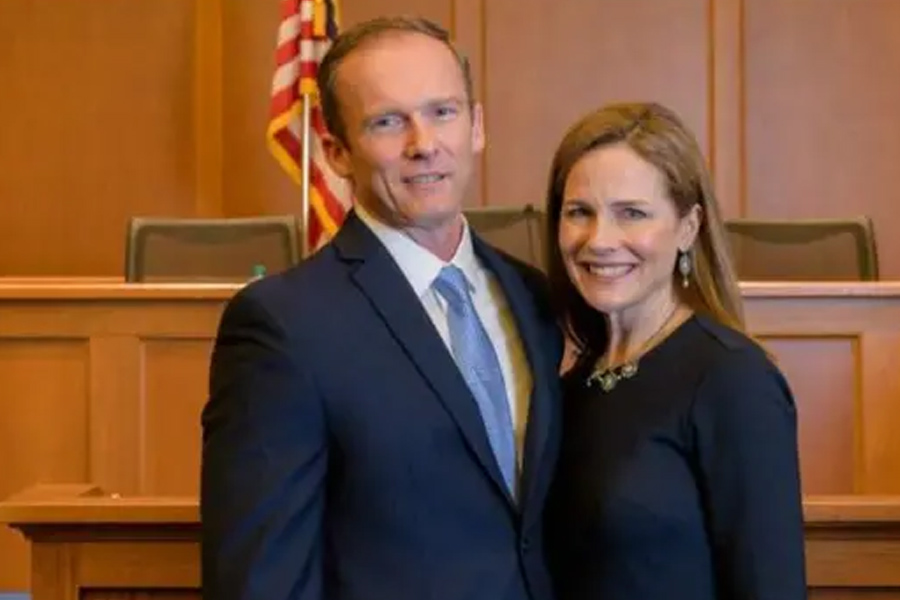
Basic Background
Jesse M. Barrett is an American lawyer with a discreet public presence and a durable professional record. He is best known as the husband of U.S. Supreme Court Justice Amy Coney Barrett. His career spans federal prosecution, private defense work, and firm leadership. That span gives his biography a compact but substantial shape.
He earned a J.D. from the University of Notre Dame Law School in the late 1990s. There, he met Amy Coney, who later became his spouse in 1999. Their marriage has remained central to his public identity. It also frames much of the interest in his life and work.
Barrett has seven children. Two were adopted from Haiti. One child has Down syndrome. Those facts place family life near the center of his public story, even when he prefers privacy.
Education and Early Formation
Barrett’s legal education at Notre Dame set the tone for his subsequent path. The law school environment appears to have reinforced discipline, fidelity, and intellectual sobriety. Those traits fit a man who later favored steady work over spectacle. His early years remain intentionally underdescribed.
The public record suggests a birth year around 1971. Exact details about birthplace and childhood are not widely detailed. That restraint matters because it leaves his professional identity uncluttered by self-promotion. It also reflects a broader aversion to public display.
At Notre Dame, Barrett shared a formative academic setting with Amy Coney Barrett. Their relationship began in the intensity of legal study. That shared start matters because it fused personal commitment with vocational rigor. Few marriages are built from such tightly interwoven foundations.
Marriage and Household Life
The Barretts married in 1999 in Indiana. Their family later grew into a large household with complex rhythms. Seven children require order, patience, and logistical precision. That reality often shaped how their public duties were managed.
During Amy Coney Barrett’s confirmation process, Jesse handled many domestic responsibilities. That support allowed the family to remain functional during demanding public scrutiny. It also revealed a practical domestic division of labor. The arrangement appears to have been cooperative rather than ceremonial.
Their children include both biological and adopted members. One adoption occurred in infancy, and another followed the 2010 Haiti earthquake. Those decisions suggest deliberation, steadiness, and an expansive view of kinship. The family narrative is marked by both gravity and tenderness.
After Amy’s 2020 appointment to the Supreme Court, the family relocated from Indiana to Virginia. That move represented another recalibration. It aligned household geography with national judicial obligations. The transition preserved family continuity while responding to changing circumstances.
Career in Public Service
Barrett spent more than a decade as an Assistant U.S. Attorney in the Northern District of Indiana. His federal service likely began around 2005 and lasted until 2018. That period formed the backbone of his legal reputation. It was a long apprenticeship in criminal litigation.
His prosecutorial work focused on white collar matters. That included commercial fraud, tax schemes, and regulatory violations. He first-chaired more than 20 criminal trials. Such a record indicates substantial courtroom maturity and procedural command.
Federal prosecution demands composure, precision, and endurance. Barrett’s years in that environment suggest a methodical professional temperament. He would have needed to synthesize facts quickly and present them persuasively. Those are transferable skills in later defense practice.
His public image during those years remained comparatively muted. He did not cultivate celebrity through his office. Instead, he appears to have accumulated credibility through outcomes and reliability. That kind of reputation often travels farther in legal circles than publicity.
Private Practice and Firm Leadership
In 2018, Barrett moved into private practice at SouthBank Legal. He later became managing partner and helped launch the firm’s Washington, D.C., office in 2021. That progression indicates more than a change in employer. It shows a shift from public enforcement to private advocacy and leadership.
His practice areas include white collar defense, internal investigations, and complex litigation. Those fields reward judgment, discretion, and technical fluency. They also demand familiarity with both corporate risk and criminal exposure. Barrett’s prosecutorial background likely sharpened his usefulness in those matters.
A lawyer who has tried cases from the government side often brings useful perspective to defense work. Barrett fits that pattern. He likely understands how prosecutors think, how records are built, and where weaknesses tend to surface. That kind of fluency is a practical asset.
In 2024, he represented Fox Corporation in defamation litigation in Illinois. The case drew attention because of his spouse’s role. Even so, it remained a standard private legal engagement. That distinction is important because it keeps the focus on his professional work.
Family and Public Profile
Barrett’s public profile remains low. He has little apparent personal social media presence. He grants few interviews and rarely seeks the stage. That restraint gives his biography a sober tone.
When he does appear publicly, the emphasis tends to fall on family rather than self. The available glimpses show a man involved in domestic life and legal work. He seems to prefer competence over charisma. That preference is uncommon in modern public life, where visibility is often mistaken for stature.
His family life has also drawn attention because of the demands of high office. Balancing seven children, a judicial household, and a private legal career requires more than organizational skill. It requires a durable institutional temperament at home. Barrett appears to embody that kind of steadiness.
The family’s move to Virginia after 2020 also altered their public geography. That relocation connected them more directly to the nation’s capital. Yet the household has continued to project privacy. The contrast between proximity to power and personal reserve remains striking.
Financial Snapshot
Publicly described figures suggest the Barrett family’s net worth was around $4 million in 2024. That estimate is broad, but it reflects home equity, investments, and professional earnings. The household appears financially comfortable without extravagance. The balance sheet reads as careful rather than ostentatious.
| Category | Approximate Detail |
|---|---|
| Home | About $2.2 million |
| Mortgage | Substantial balance in the low seven figures |
| Investments | Low to mid seven figures historically |
| Jesse’s public service pay | About $150,000 to $170,000 annually |
| Private practice income | Higher than government compensation |
| Family size | Seven children |
These figures are snapshots, not live accounting. Still, they suggest a household shaped by professional discipline. The pattern is consistent with restrained accumulation. It also aligns with a long-term orientation rather than speculative appetite.
Ethics and Media Attention
Barrett’s name occasionally appears in ethics discussions because of his spouse’s judicial office. That is a natural consequence of visibility near the Supreme Court. Still, the professional record described publicly has not produced substantiated recusal crises. His work proceeds within ordinary private practice boundaries.
Media attention usually arrives in connection with a case or a family milestone. It rarely expands into broader celebrity. That limited exposure has preserved his low-key image. In a noisy public environment, that itself is notable.
His professional life illustrates how proximity to national power does not require public theatrics. He works in a field where discretion can be a strategic strength. That makes him legible as a serious lawyer rather than a public personality. His biography is defined more by continuity than by reinvention.
Selected Timeline
| Year | Event | Detail |
|---|---|---|
| c. 1971 | Birth | Approximate year, exact date not publicly detailed |
| Late 1990s | Law school | Earned J.D. from Notre Dame Law School |
| 1999 | Marriage | Married Amy Coney in Indiana |
| 2003 | Bar admission | Admitted to the Indiana Bar |
| c. 2005 | Federal service | Joined the U.S. Attorney’s Office in Northern Indiana |
| 2005 to 2018 | Prosecutor | Led white collar investigations and tried more than 20 cases |
| 2018 | Private practice | Joined SouthBank Legal |
| 2020 | Family move | Relocated to Virginia after the Supreme Court appointment |
| 2021 | D.C. expansion | Helped open a Washington office |
| 2024 | Major litigation | Represented Fox Corporation in defamation litigation |
| 2025 | Ongoing work | Continues as managing partner |
This timeline shows a linear, disciplined career. The arc does not depend on abrupt reinvention. Instead, it shows cumulative professional trust. Each stage built on the previous one.
Professional Traits and Family Culture
Barrett’s professional life suggests exactness, patience, and tact. Those qualities matter in both prosecution and defense. They also matter in a household with many children. The overlap between home and work is hard to miss.
His family culture seems grounded in routine and mutual dependence. That kind of stability is often invisible from the outside. Yet it is usually what sustains long careers and public service alike. Barrett’s life illustrates that quieter truth.
The combination of federal service, private leadership, and large family obligations gives his biography unusual density. He is not a public theorist or political showman. He is a working lawyer with a carefully bounded public identity. That distinction gives the story its substance.
Key Takeaways
Jesse M. Barrett is a Notre Dame educated lawyer with a long record in white collar criminal work. He spent more than a decade as a federal prosecutor before moving into private practice in 2018. He later became managing partner at SouthBank Legal and helped open its D.C. office in 2021.
He and Amy Coney Barrett married in 1999 and have seven children. Their family includes two adopted children from Haiti and one child with Down syndrome. The household relocated from Indiana to Virginia after 2020.
His public profile remains modest, but his professional record is durable. He is best understood as a disciplined litigator, a private family man, and a lawyer whose credibility has been built through sustained practice.


